
The Commute Math Nobody Does
Why "30 Minutes to Downtown" Means Something Different in February

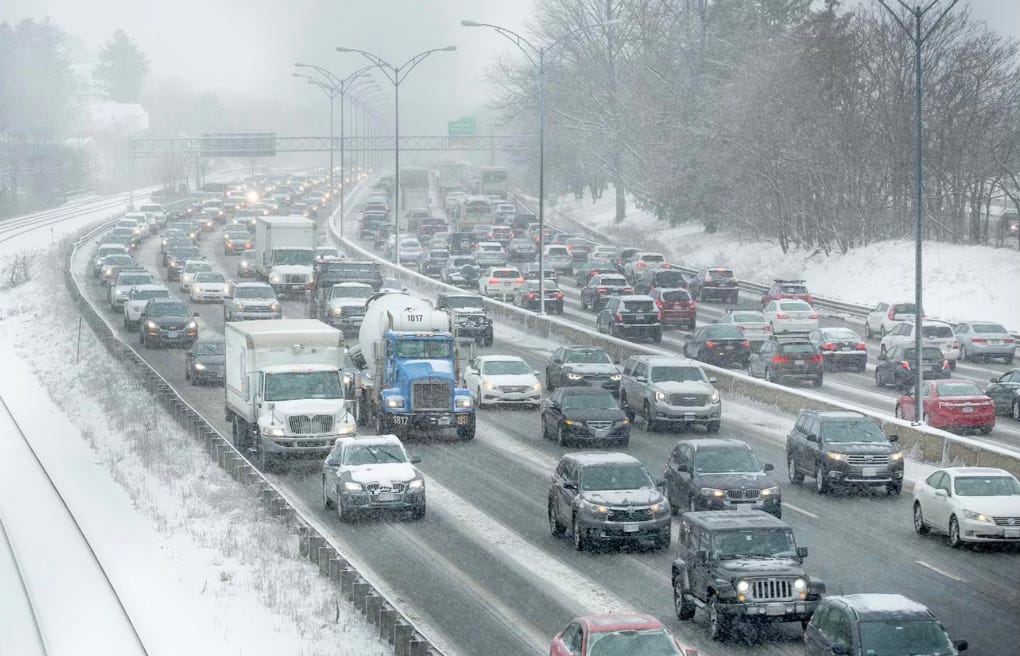
Google Maps says 20 minutes. Your morning reality says 50.
That’s the gap that catches every out-of-state buyer off guard, and it’s not about traffic. It’s about winter. It’s about the T. It’s about the difference between what looks easy in June and what actually works in February.
The commute issue doesn’t show up in the inspection report. It shows up three months after closing, when you’re standing on a frozen platform at 7:45am watching the third delayed Red Line train crawl by.
The MBTA Winter Reality
The Red Line has some of the oldest subway cars in the country. During the January 2026 snowstorm that dropped nearly two feet on Boston, multiple disabled trains resulted in delays of 20 and 30 minutes, and some trains were even pulled out of service. An MBTA spokesperson confirmed that some of the Red Line’s oldest cars struggled as a result of the single-digit temperatures and snow.
This isn’t an anomaly. It’s the pattern.
According to MBTA data, they measure reliability using “excess trip time”. The difference between a rider’s actual trip time and their expected trip time. A trip is counted as “reliable” only if the excess trip time is five minutes or less.
Translation: If your commute takes five minutes longer than expected, the MBTA considers that acceptable. If it takes ten or fifteen minutes longer, which happens regularly in winter, that’s just part of the experience.
According to recent analysis, the Red Line passenger experience continues to degrade due to poor headway management and frequent delays caused by disabled trains and signal problems. Winter makes this worse.
What buyers don’t anticipate:
Train delays from signal problems (which the T estimates cause roughly 30% of delays)
Reduced service in extreme cold (fewer trains running means longer waits, more crowded platforms)
Walking to the station in February weather (that “8-minute walk” becomes 12-15 minutes navigating ice and snow)
Platform wait times when trains are delayed or disabled
Packed trains during rush hour where you literally can’t board
A January 2026 commuter described the scene: The train platform “was piled super, super deep” with waiting passengers. “When the train finally showed up, there was only enough room for maybe 10 percent of us to get on the train, because it was so packed.”
This is the commute reality Google Maps doesn’t capture.
When “Reverse Commute” Doesn’t Mean What You Think
Buyers from other cities hear “reverse commute” and assume easy, fast, stress-free.
Sometimes that’s true. But in Boston, reverse commute depends heavily on where you’re going and how you’re getting there.
The car-dependent reverse commute:
If you’re living in the city and driving out to Burlington, Waltham, or Route 128 suburbs, you’re still hitting Route 93, Route 2, or the Mass Pike during rush hour. Winter accidents, lane closures, and snow make these routes unpredictable.
That “easy 30-minute drive” can become 50-70 minutes when a truck jackknifes on 93 or when freezing rain slows traffic to 20 mph.
The T-dependent reverse commute:
If you’re relying on commuter rail for a reverse commute, you’re dealing with different challenges:
Reduced off-peak frequency (trains every 60-90 minutes vs. every 15-20 during peak)
Weather-related delays and cancellations
Limited flexibility if you work non-standard hours
During the same January 2026 winter storm, there were a number of delays and cancellations for the Commuter Rail, attributed to ongoing winter storm impacts and continued cold temperatures. The MBTA explained: “Snow, ice buildup, and extreme cold all have negative impacts on critical railroad infrastructure such as switches as well as on engines and doors on board trains.”
The bottom line: A reverse commute works great in September. In February, it’s subject to the same weather and infrastructure challenges as any other commute.
The Signal Problem You’ll Hear About Constantly
If you ride the T regularly, you’ll become intimately familiar with the phrase “experiencing delays due to signal problems.”
Here’s what that actually means: The signal system is “the intelligence that helps trains move”. It lets train operators know how fast they can drive, and allows the control center to keep tabs on where trains are. Anything that disrupts the spreading of that information can be labeled as a “signal problem.”
The equipment being replaced on the Red and Orange lines is approximately 50 years old. The MBTA is currently in the middle of a $295 million project upgrading the signal system on the Red and Orange lines, but until that’s complete, delays from signal issues will continue.
Just over half of the subway system’s signal infrastructure was out of a “state of good repair” as of July 1, 2021, according to a T analysis. Translation: The system is harder to maintain and more prone to failure.
What this means for your commute:
Unpredictable delays (could be 5 minutes, could be 30)
“Signal problem” alerts happen year-round, but winter compounds the issues
No real way to plan around it (you just build buffer time into your schedule)
One MBTA rider put it simply: “Maybe I have to pay attention. But I wish the T gave riders more information about what, specifically, it’s working on that causes delays.”
The Parking Reality (If You’re Driving Instead)
Some buyers decide the T isn’t reliable enough and plan to drive to work instead.
That works, until you factor in the full cost:
Downtown parking costs:
$30-50 per day for garage parking
$300-400+ per month for a reserved spot
Street parking (where it exists) is metered, limited, and competitive
Tunnel tolls:
Sumner Tunnel, Ted Williams Tunnel, Callahan Tunnel: Tolls add up fast when you’re commuting daily
Snow emergency complications:
Parking bans on certain streets overnight
Digging your car out after a storm (adds 15-20 minutes to your morning)
Finding street parking after a snowstorm when half the spots are buried or taken by snow piles
A Phoenix transplant planned to drive from Somerville to the Financial District. Google said 15 minutes. They didn’t account for: finding street parking after a snowstorm (20+ minutes), digging out their car (15 minutes), tunnel traffic delays, and downtown parking costs ($35/day).
Real cost: 50+ minutes each way, plus $700/month in parking. They bought a T pass within two months.
What Smart Relocating Buyers Actually Do
The buyers who get this right ask different questions during the house-hunting process:
✅ “What’s the commute like in February, not just on Google Maps in ideal conditions?”
✅ “How reliable is this specific T line in winter weather?”
✅ “What’s my backup plan when the Red Line has signal problems or disabled trains?”
✅ “Can I realistically walk to the T in bad weather, or will I need to drive/take a bus to the station?”
✅ “If I drive, what does parking cost at my office, and where will I park at home after snowstorms?”
One buyer from Denver specifically scheduled a January visit to test their commute. They left their hotel at 8am on a Tuesday and took the T to their office during actual winter conditions.
The commute took 47 minutes instead of the 28 Google predicted. They immediately adjusted their neighborhood search to cut 15 minutes off the real commute.
No regrets. No surprises in February.
The Truth About Boston Commutes
Here’s the reality: Boston’s public transit is old, under-resourced, and challenged by winter weather in ways that newer city systems aren’t.
The MBTA is actively working on improvements, track upgrades, signal modernization, new train cars on order (though those vehicles are running years behind schedule). But these are multi-year projects.
In the meantime, winter commutes in Boston require:
Extra time built into your schedule
Backup plans for when the T fails
Realistic expectations about reliability
Understanding that “30 minutes on Google Maps” and “30 minutes in February reality” are two different things
Some buyers embrace this as part of urban living. Others realize they need to live closer to work, or choose neighborhoods with multiple transit options, or factor in car ownership and parking costs.
None of these choices is wrong, as long as it’s an informed choice made before you close on a home.
Agent-to-Agent: The Commute Conversation
The commute discussion goes deeper than “where’s your office?”
Worth asking relocating clients:
Have they experienced winter public transit before, particularly older systems?
What’s their tolerance for commute variability? (Some people handle unpredictability well; others find it draining)
Do they have flexibility in start times, or must they arrive by 9am sharp?
Are they used to reliable, modern transit (like newer systems) or car-dependent cities?
What’s their backup plan if their primary commute method fails?
These answers shape everything. Which neighborhoods actually work, whether they need parking, whether they should be near multiple T lines for redundancy.
A commute that adds 20-30 minutes of variability doesn’t just affect the morning. It affects whether someone stays in Boston long-term.
Let’s Connect
Sending a client to Boston who’s planning their commute around Google Maps estimates? Let’s talk through the winter reality before they commit to a location.
More next Sunday.